Where Art Meets AI – Part I

Years ago I wrote the story “SPECTRA’S MASTERPIECE” in my book The Cemetery of Hearts.

However, it seems timely today, as it deals with the intersection of AI and art.

I’ll post the story in several different parts over the next several weeks.

I hope you enjoy “SPECTRA’S MASTERPIECE”!

____________________________________________________________________________________

SPECTRA’S MASTERPIECE – PART I

It was utterly breathtaking--amazing I would say but the word does the piece no justice.  

Somehow, Michael Spectra had managed to create four masterpieces in one.

I was beginning to think that he might be the best after all.

The holomorph was entitled "The Four Corners of the World." The landscapes alone would have generated critical acclaim. But the women raised the piece from contemporary statement to eternal treasure.
Conceptually the morph is absurdly simplistic.  At the top of the world, which is seen by rotating the body skyward in the VR harness, fantastic snow-covered peaks reach towards the steel-blue heavens.  Beasts of prehistoric times own the slopes, thunderous wooly mammoths and silent saber tooth hunters.  The nerve manipulators prickle the senses with icy flashes, and the cyclic moan of the wind through the high mountain passes flood the auditory senses.

Spinning the body towards the ground so that one hangs suspended upside down reveals the equatorial zone--lush and green with venomous plants climbing over Mayan ruins. The sun dominates the red sky overhead, and the nerve manipulators raise the body temperature until you are covered with beads of sweat. Large reptiles with emerald eyes slither in and out of the shadowy jungles.

Leveling out and spinning the body to the right one sees Spectra's interpretation of the Far East. Prayer bells and incense fill the senses, and throngs of bicyclists stream around you on the claustrophobic New Tokyo streets in an avalanche of squeaky wheels and color. Hindu temples ring the distant hills, towering portraits of the strange and mysterious pantheon of the Upanishads.

Spinning the body to the left one is greeted by the majestic American West. Insects glide and buzz around the viewer in minute choreography as eagles wheel and cry above the swaying fields. The seemingly impregnable peaks of the Rockies beckon in the scented summer breeze.

But greater than these things, and always the central element in each of the visual novellas, is the woman...

Stay tuned for Part II!


Tommyknockers, Tommyknockers, Knocking at My Door!

The Tommyknockers is the story of a buried spaceship in the Maine woods. The story’s female protagonist, Bobbie, a somewhat solitary writer of Westerns, discovers the ship. Another prominent figure in the movie is Gardner, an alcoholic poet and Bobbie’s companion. Bobbie becomes obsessed with excavating the ship after feeling a strange energy flow through her when she touches its metallic surface. Soon she has the ability to build wondrous machines, such as a psychic typewriter that writes her novels while she dreams.

Along with Bobbie’s new-found mechanical skills are startling physical changes as well, much like those suffered by victims of radiation sickness. She loses weight, teeth, and patches of hair as she uncovers more and more of the ship. Soon the ship’s toxic influence affects the entire town, like a malignant cloud, and soon all of the townspeople are involved in the excavation of the mammoth ship. Only Gardner, who has a metal plate in is head from a previous injury, is immune to the effects of the Tommyknocker ship.

The Tommyknockers uses many elements to convey both its overt message and its subtext. First are the very real melodramas going on in the small town and the skillful characterization of its citizens. While some of the bit characters are stereotypes (for example, the lusty young postal worker as the “town whore” stereotype, played by Traci Lords), the main characters are well developed and interesting. What brings the conflicts between the townspeople to light is their newly-found ability, courtesy of the Tommyknockers, to read the minds of one another. In several extreme cases, these differences of opinion are enough to drive the citizens to murder.

A second major element, presented as subtext, is the effects of the Tommyknocker ship as the allegory to the terrible effects of nuclear radiation. King has admitted to this none-too-subtle metaphor in the story as a way to play upon society’s fear of nuclear power and the deadly potential of the world’s nuclear arsenal. Th e Tommyknocker’s power glows green like radiation, and causes rapid physical deterioration. King presents the downside of nuclear energy in dialogue as well, during a reception in which a drunk Gardner confronts a nuclear power plant executive.

Another common theme in The Tommyknockers is that of the outsider versus the group. As the Tommyknocker ship affects the town, they develop a mass consciousness and the ability to communicate telepathically. Gardner, who is immune to the ship, represents the outsider and therefore a threat to the common goal of the group to excavate the ship.

King also presents a mechanized monster in the film, a concept he would explore much more deeply in Trucks and Maximum Overdrive. In The Tommyknockers, the mechanical menace is a Coke machine that goes haywire and ends up killing the grandfather in the movie.

There is also the concept of the haunted woods where Bobbie discovers the alien ship. It is located in a part of the Maine woods called by the Indians “The Burning Woods” due to the strange lights that are seen there, and as Bobbie unearths the ship the woods glow radiation green.

It is interesting to note King’s treatment of law enforcement in the movie. In his college days King was something of a rebel, an anti-establishment “long hair” that participated in several anti-war demonstrations on campus.

Despite this, his most ethical and heroic characters often come from the local police force. Th is may come from King’s own exposure to small town police, or may simply be King’s attempt to show the reader a small town way of life and its sharp contrasts to the corruption and crooked politics of the big city. In any case, the police do their best to stop the Tommyknockers (albeit not successfully) and are shown in a very positive light. It is also interesting to note that the town sheriff in King’s Storm of the Century is also portrayed as a hero in that movie as well.

Like many of King’s works, The Tommyknockers includes a short chant-like poem that is repeated throughout the film to reinforce the terror:

Last night,

And the night before,

Tommyknockers, Tommyknockers,

Knocking at my door.

King often uses children as the mouthpieces for these messages to show that the innocents (King rarely presents saint-like adults; almost all are flawed in some respect) have been “turned” by the evil forces.

We All Want a Piece of the Pie: A Review of Stephen King’s Thinner

Thinner is the story of a man inflicted with a gypsy curse that causes him to uncontrollably lose weight. It is based on the novella of the same name included in The Bachman Books, a collection of four short novels written by King under the pen name Richard Bachman.

The movie starts with a gypsy caravan arriving in a small Maine town. The audience immediately feels the clash of cultures between the white, well-established townspeople and the transient gypsies. On the one hand, it is obvious that the arrival of the gypsies provides excitement and change to the everyday routine of the townspeople, as evidenced by a scene when the movie’s protagonist, Billy Halleck, and the town judge are leering from a courthouse window at a young gypsy woman. At the same time, the town seeks to drive the gypsies out on some trumped-up zoning laws, and views them as carriers of disease and as possessing questionable moral values (there is an interesting commentary here on small town life, as the viewer gets the sense that any group of outsiders would be similarly ostracized). To perhaps highlight the “grey areas” of the town’s moral hypocrisy, the movie begins with Halleck, an obese attorney, defending a known mobster. Halleck wins the case, and the loyalty of his client.

Problems arise when a slightly intoxicated Halleck and his wife start fooling around in the car while driving home from the law firm’s victory dinner. Halleck accidentally hits and kills an old gypsy woman on the street. For appearances, the matter is investigated but a cover up between Halleck, the town sheriff , and the town judge keep Halleck from serving any time. On the way out of the courthouse, an old gypsy touches Halleck’s cheek and utters one word: “Thinner.” From that moment on, no matter how much he eats, Halleck begins to lose weight (the remainder of the movie involves Halleck and his charming, but violent, friend from the mob trying to coerce the gypsies to remove Halleck’s curse).

Thinner is an interesting movie because it successfully inverses values and norms to keep the viewer off balance. For example, the life of the townspeople is portrayed as sterile and rigid, compared with the overt sexuality and freedoms enjoyed by the nomadic gypsies. In another reversal, the local “upstanding” townspeople are seen committing immoral acts as opposed to the “lower class” outsiders. There is a criminal who is loyal to his word. Finally, at the end of the movie, there is the concept of a “death cake,” a food that drains life force as opposed to providing nourishment. This is the polar opposite of the supernaturally enhanced manna described in the bible that allowed the Israelites to survive their exodus in the desert.

Unlike many of King’s protagonists, Billy Halleck is not moral or rational in the end. He is warned by the old gypsy to save what is left of his soul by taking his own life. The gypsy’s ominous warning is powerful: “Die clean, white man from town! Die clean!” Instead, Billy chooses revenge with tragic consequences. The usage of an antihero is most likely reflective of the period of King’s life in which Thinner was written (the teenager in the short novel Rage, also included in The Bachman Books, chooses an equally dark path).

In an America that is growing more obsessed with weight loss, Thinner provides a stark warning of the downside of crash diets, bulimia, and popping pills to stay thin.

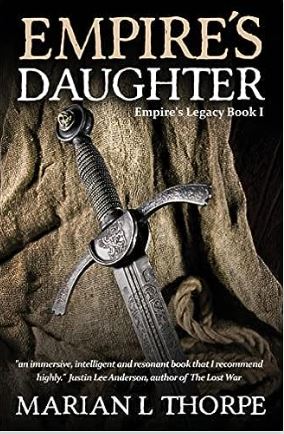
Unlikely Heroes: A Review of Marian L. Thorpe’s Empire’s Daughter

For generations, the women of the coastal fishing village of Tirvan have lived separately from the men. The elders decided long ago that the men were needed to defend the northern wall and fight foreign wars, while the women would provide food and clothing, and raise the children. Only once a year would the men visit the village during a time of festival. During festival, mates were chosen to ensure that there would be future generations of soldiers and women to provide for them.

But a new threat is threatening Tirvan. Raiders from the island of Leste are preparing to attack the peaceful and unprotected coast. An emissary from the empire has come to Tirvan bearing the grave news, and to instruct the women in the ways of war, and the use of sword, bow and spear.

Like Marian L. Thorpe’s longer epic Empress & Soldier, the author skillfully draws the reader into the tale, and the reader can smell the sea and feel the coarse ropes of the fishing nets against their hands as if they were living the story. This is the first book of the Empire’s Legacy series, and it keeps the reader hungering for more.

Can the women of Tirvan find the resolve to defend their homes against the invaders, or will war tear apart their peaceful lives? Read this highly recommended book and find out.

A Rose by Any Other Name: A review of Stephen King’s Rose Red

Rose Red is Stephen King’s mini-series that represents his most direct attempt at a haunted house story.

In King’s nonfiction book on the horror genre, Danse Macabre, King gives high praise for Shirley Jackson’s The Haunting of Hill House, and one gets the impression that King has been eager to embrace this subject matter for some time.

Unlike the films The Haunting and The Haunting of Hell House (not to be confused with Jackson’s The Haunting of Hill House), Rose Red does not rely heavily on computer-generated images to scare the audience. Not surprisingly, King makes the most of the longer mini-series format to provide the audience with a rich history of a fictional manor outside of Seattle and to introduce the viewer to the unusual group of psychics that have gathered together to explore it.

While the common mechanisms of haunted house stories include walking corpses, rattling chains, and the occasional door to another dimension, King provides the audience with something altogether more innovative—a house that rebuilds itself, ever expanding and changing the layout of its rooms. This goes well with the common concept in horror of the haunted house as a living entity, one whose malignant and ancient personality exerts force over the physical world with tangible and often terrifying results. Rose Red is not simply a vast psychic tape recorder; it is a huge amplifier and shifting landscape for the sad and twisted souls that once lived and breathed within its walls.

King spends adequate time on characterization in Rose Red, from the driven professor leading the expedition who may be more interested in retaining tenure at the university than she is in unlocking the mysteries of the venerable estate to the introverted, hyper-sensitive little girl that may hold the key to Rose Red’s secrets, to the ghost-widow Ellen Rimbauer who haunts the manor’s sliding stairways and musty attic.

King understands that horror works if the viewer or reader can be enticed to suspend their disbelief. More than any other genre, horror places a tremendous burden on the rational reader, and King makes sure that the viewer/reader is rewarded by being introduced to an array of compelling characters before being pulled down into “the dark void.”

Although not the greatest ghost story ever told, Rose Red represents an almost necessary development for King, one that his body of work would appear incomplete without. While arguably the Overlook Hotel in The Shining is simply a larger form of the haunted house, the emphasis in The Shining is on the father’s descent into madness more than the hotel itself. In Rose Red, the manor itself is the main driver of the homicidal impulse.

If nothing else, King, such an avid fan of Peter Straub’s Ghost Story and Shirley Jackson’s The Haunting of Hill House, had to add one more haunted edifice to an already crowded landscape.

Developed relatively late in King’s career, one gets the sense that the ideas behind Rose Red, like the ever-changing manor itself, had been growing in King’s mind for many years.

Back from the Dead: A Review of Stephen King’s Pet Sematary

Pet Sematary is the story of a doctor’s family that moves to Maine. Close to the property the family discovers a large pet cemetery, complete with makeshift headstones and eulogies to the deceased companions. The widower next door warns the family of the woods beyond the pet cemetery that in previous times contained an Indian burial ground.

The Indian burial ground has the power to bring back the dead, but only at a terrible cost. It is a new twist on an old idea, one present in Mary Shelley’s Frankenstein and other horror classics. It is the cautionary tale of playing God and reaping the consequences.

Pet Sematary is truly a modern tragedy. In classic King style, non-supernatural events are interwoven with supernatural events, drawing the reader into the story and enabling them to suspend their disbelief. For example, the family’s shy housekeeper hangs herself, a student at the local university is hit by a car and dies on the examination table in front of the doctor, and the audience is shown a flashback of what the Doctor’s wife endured growing up with a sister with spinal meningitis.

In my opinion, Pet Sematary is one of the most terrifying movies based on King’s work because of the multiple psychological pressure points it strikes and the large dose of human tragedy injected into the tale. When the viewer is shown the horrible physical appearance of the wife’s sister as she suffers with her disease, the viewer is reminded of “the shunned house” in their own neighborhood, that house that is avoided by the neighborhood kids due to whispered rumors that may or may not have been based upon true events. Although the motives behind the housekeeper’s suicide are not provided (indeed, she plays a very minor background role), the tough subject of suicide is touched upon in at least a peripheral way. The tragic tale also includes the loss of a pet, the loss of a child, and the loss of a spouse.

In addition, the dysfunctional relationship between the husband and his in-laws are also brought to bear. These realistic events weave a dark tapestry that holds the supernatural elements together.

Looking at Pet Sematary from the perspective of the horror movie, many common elements of the genre are represented as well. Th ere is the concept of the haunted woods, highlighted in such genre films as The Evil Dead and King’s own The Tommyknockers. There is the concept

of the possessed pet, manifested in the vicious black dog in The Omen or King’s own infamous canine Cujo.

There is the exhumation of graves, a concept that appears in too many horror movies to list, and the living dead, presented in George Romero’s Night of the Living Dead and every

zombie film ever since. Finally, there is the appearance of the cursed child, used so well in The Village of the Damned, The Omen, and King’s own The Children of the Corn.

Due to the elements above, and the chilling way that the camera describes them, Pet Sematary is the most complete film adaptation based on King’s body of work.

One final note for rock n’ roll fans: King’s favorite band, The Ramones, is featured on the Pet Sematary soundtrack.

A Rabid Review of Stephen King’s Cujo

Cujo is the story of a rabid Saint Bernard named Cujo
that goes on a killing spree. Most writers normally
would struggle to get enough material out of such a coarse
plot to fi ll up a short story, but somehow King managed
to produce a novel on this simple premise that was later
turned into a film.

Like many of King’s works, the actual threat or
“horror” plays a background role to the characters in the
story, which are richly fleshed out. The young family
in Cujo is certainly not the Brady Bunch; indeed, they
are in the midst of a significant family crisis, with the
couple barely speaking and the wife engaged in an affair
with another man. In addition to helping the audience
identify with the characters as real people, the family crisis
is skillfully used by King as a plot catalyst to isolate the
mother and son in the latter half of the movie.

This deteriorating state of affairs provides an
interesting parallel to Cujo’s own deteriorating physical
and mental health after being bitten by a rabid bat. This
provides an extra level of dramatic tension. The audience
knows that Cujo’s state is not likely to improve–is the
author also attempting to foreshadow a similar fate for
the family?

Cujo’s linear plot makes it successful. It starts
slowly, but early events make it evident that an explosive
climax is on the horizon. In one early scene, the boy of
the family that owns Cujo goes out looking for the dog
on a foggy night. Th e audience is shown Cujo’s hulking
form appear in the mist behind the boy, and it feels as if
at any moment an attack is imminent. Nothing happens, and
the terror subsides, but Cujo’s murderous potential is
masterfully hinted at before it becomes real several scenes
later.

In another scene designed to cause discomfort,
King probes at another fear, the fear of ingesting tainted
food and water, when the husband’s cereal company’s
new brand starts causing kids to get sick. The audience is
also let in on the wife’s affair well before the husband is,
providing another potential land mine that can erupt at
any moment.

The final confrontation in Cujo is brutal and
ferocious, but also very primal in a way that is easily
identified by the audience, if even on a subconscious level.
At its root, it is a mother protecting her young from the
predators of the wild. Although Cujo’s attack starts while
the mother and son are in the car, this modern contraption
is soon forgotten as it is smashed to bits during the epic
battle.

Wisely, King does not try to evoke sympathy for
the sick and feverish Cujo in the middle of this sequence.
Cujo comes at the mother and son again and again like
a freight train. His aggressiveness does not dissipate
over the hours and it is clear that Cujo has become a pure
killing machine, making any injuries suffered by the beast
tolerable; almost morally validated.

One other point of note is that Cujo contains a
very strong female character, as do other King big screen
adaptations such as Delores Claiborne, The Tommyknockers
and Misery.